
X-keys on Raw Panel 🔑
The SKAARHOJ X-keys app (package xpanel-xkeys) lets you use X-keys from P.I. Engineering with SKAARHOJ products that have the Blue Pill platform inside, alongside your SKAARHOJ panels.
- Mix X-keys with SKAARHOJ controllers, and configure them in Reactor.
- No computer needed: the X-keys plugs straight into the SKAARHOJ device.
- Raw Panel puts the X-keys on the network, with PoE on the SKAARHOJ side.
- Add special workflows with X-keys foot pedals, T-bars, jog/shuttles, joysticks and switch interfaces.

Each X-keys becomes a Raw Panel on its own TCP port. Reactor, or any other Raw Panel client, uses it like a SKAARHOJ panel: it sets the key backlights and gets presses and jog, shuttle, joystick and T-bar movements back.
The app's web interface shows a live copy of every X-keys with its backlights, which you can operate on screen. Here an XK-24 driven by Raw Panel Explorer (see the end of this page):
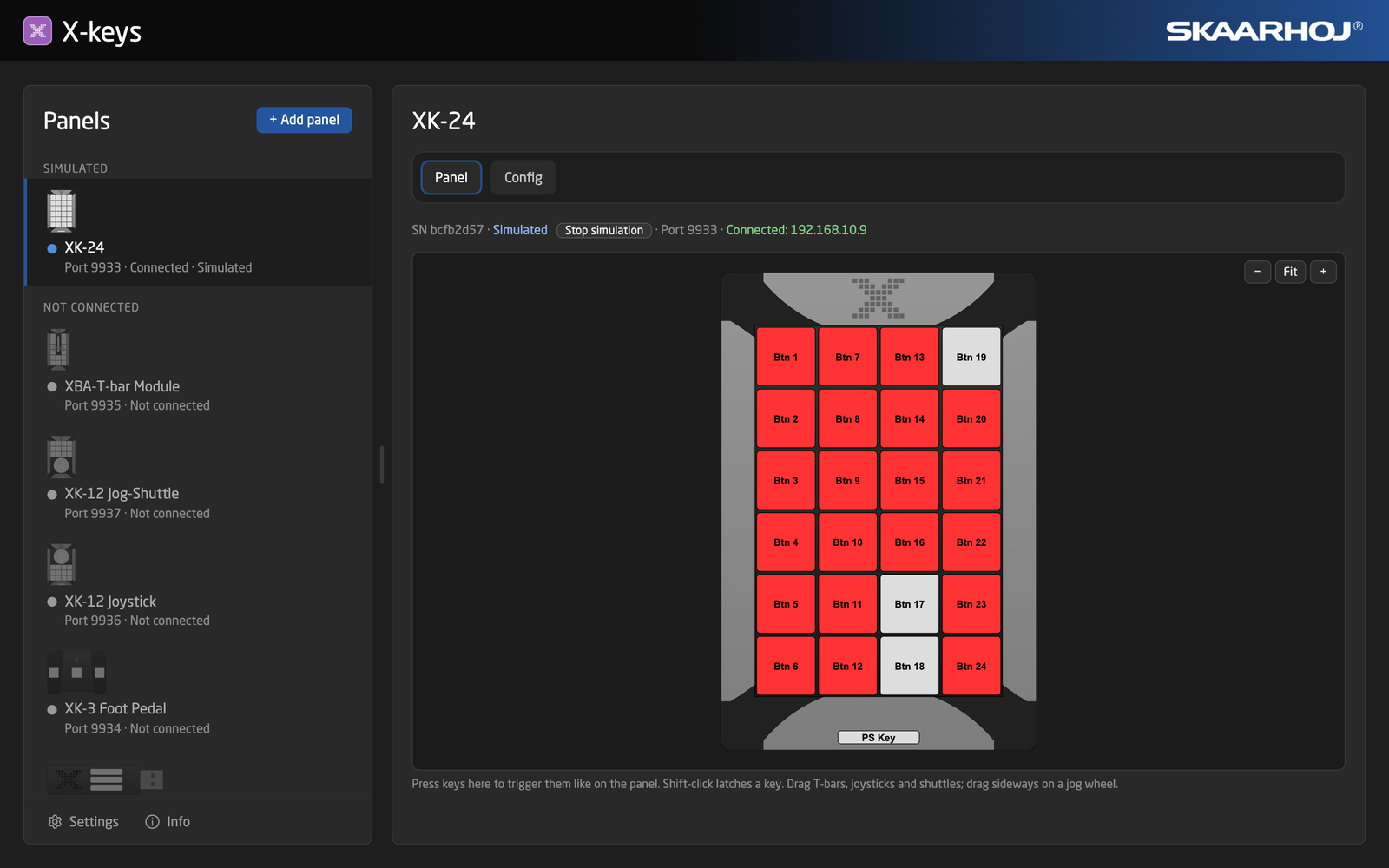
The full manual is linked from the app's Info page and attached to this page.
Supported Models
| Model | Controls | Photo |
|---|---|---|
| XK-24 | 24 keys, program switch |  |
| XK-12 Jog-Shuttle | 12 keys, jog and shuttle, program switch |  |
| XK-12 Joystick | 12 keys, joystick (rotation is an encoder), program switch |  |
| XK-60 | 60 keys, program switch |  |
| XK-80 | 80 keys, program switch |  |
| XK-68 Jog-Shuttle | 68 keys, jog and shuttle, program switch |  |
| XK-68 Joystick | 68 keys, joystick, program switch |  |
| XKE-64 Jog T-bar | 64 keys, jog and shuttle, T-bar |  |
| XKE-124 T-bar | 124 keys, T-bar |  |
| XKE-128 | 128 keys |  |
| XBA-T-bar Module | 14 keys with RGB backlights, T-bar. A 3D-printable stand that aligns it with SKAARHOJ products like Air Fly: XKE-14_T-bar_XC_v2.step |  |
| XKE-40 | 40 keys (rack unit), program switch |  |
| XK-4, XK-8, XK-16 Stick | 4, 8 or 16 keys, program switch |    |
| XK-3 Foot Pedal | 3 pedals |  |
| XK-3 Switch Interface | 3 switch inputs |  |
| XK-12 Switch Interface | 12 switch inputs (6 ports) |  |
| XK-HD15 Wire Interface | 10 inputs, 2 ports |  |
| XK-HD15 GPIO | 10 inputs/outputs, 2 ports |  |
Other X-keys models are listed as Not supported. The HWC numbers Reactor uses for each model are in the manual (with drawings) and in Raw Panel Explorer.
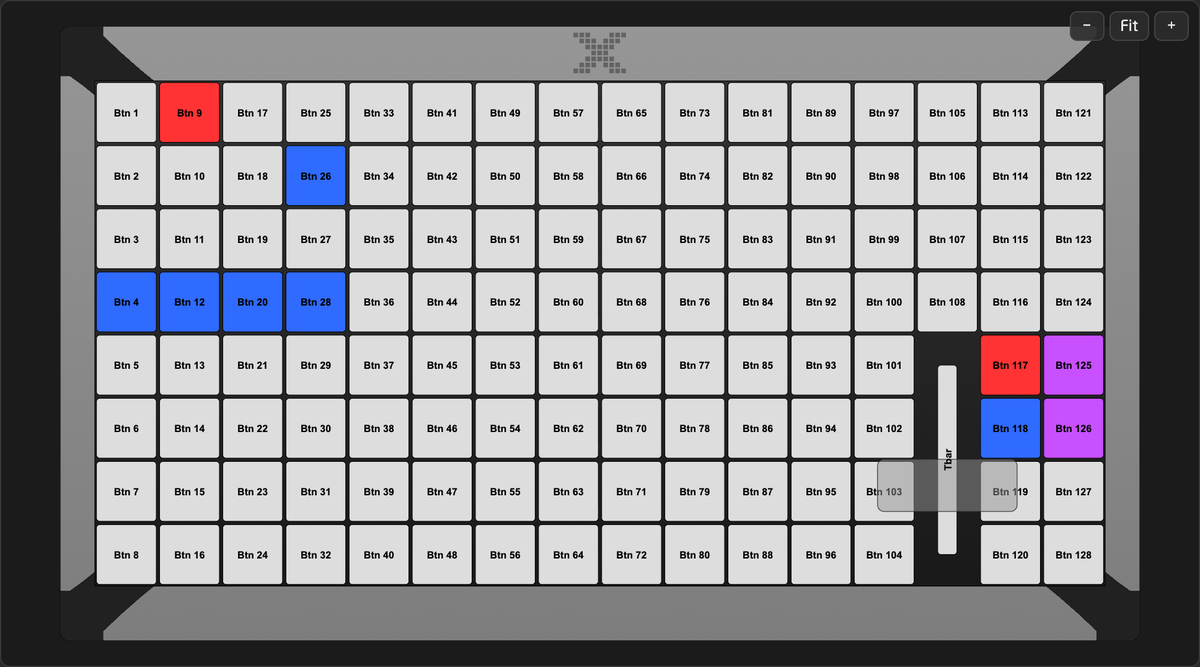
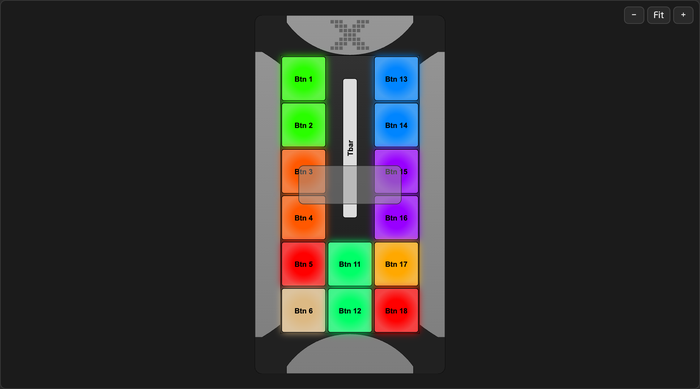
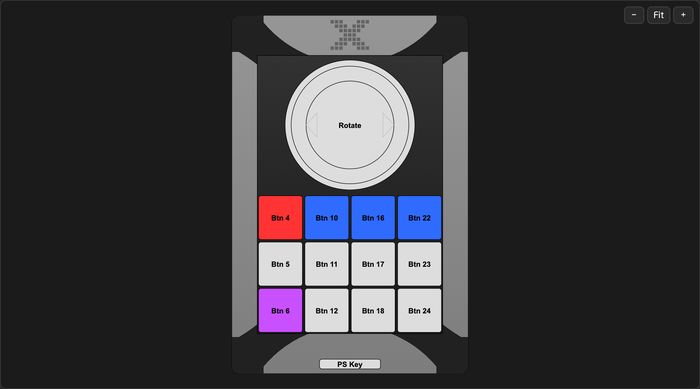
Backlights: most XK and XKE models have a blue and a red LED under each key, so they show blue, red, or both (purple). Green has no LED, so green and cyan keys stay dark. The Stick models have blue backlights, and the XBA-T-bar Module shows full RGB. The app draws the keys as the X-keys shows them.
How It Works
Here an XK-24 is connected directly to a Blue Pill Server on a PoE switch, and reached with Raw Panel on the server's IP address:

With a powered USB hub, one Blue Pill runs several X-keys:

In Reactor you find the panels on the network, add them, and assign actions to their keys, jogs, T-bars and joysticks:

Watch it
Getting Started
- Connect the X-keys to a USB-A port on your SKAARHOJ device.
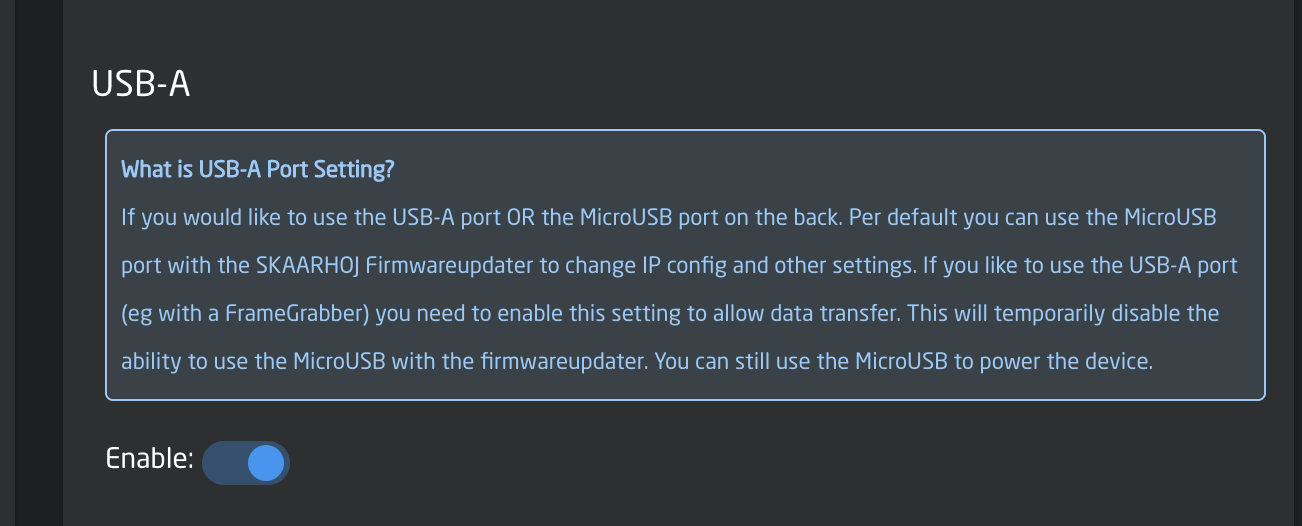
- In the device's web interface, go to Settings, turn on USB-A, power cycle the device once or twice, and check that USB-A is still on.
- Go to Packages, find X-keys under Available (XPanel group) and click Install. Once running, it has a green dot under Installed:
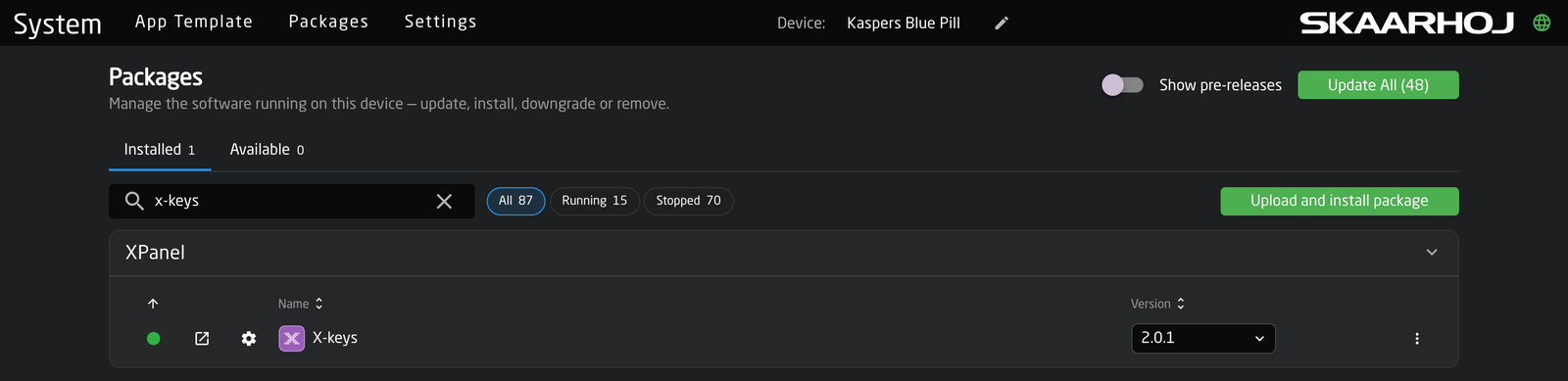
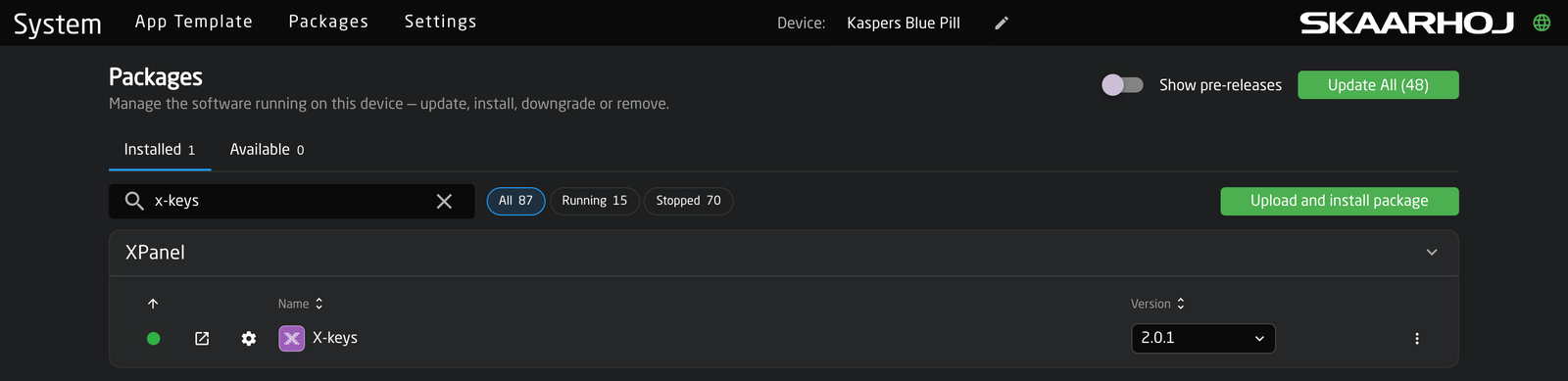
- Open the app with the open icon on the Packages page, from the device's app portal, or at
http://<device IP>/ingress/xpanel-xkeys. Your X-keys is listed under Panels with its port (9933 for the first, then 9934 and up). - In Reactor, add a Raw Panel with the device's IP address and that port, or let Reactor find it on the network (as e.g.
XP_XKEYS-XK24).

All settings live in the app; the package's skaarOS configuration page is no longer used. The X-keys has no display, so the app is where you see its port, its state and the license status.
To test by hand, use the TCP Client under Tools in SKAARHOJ Discovery, or nc <device IP> 9933 (or Telnet, or PuTTY with "Implicit CR in every LF"). Type list and press some keys to see ASCII Raw Panel triggers. Raw Panel Explorer (end of this page) is nicer.
The App
Panels are listed on the left; the selected panel is on the right, with Panel (live view) and Config (settings). Settings and Info are under the list.
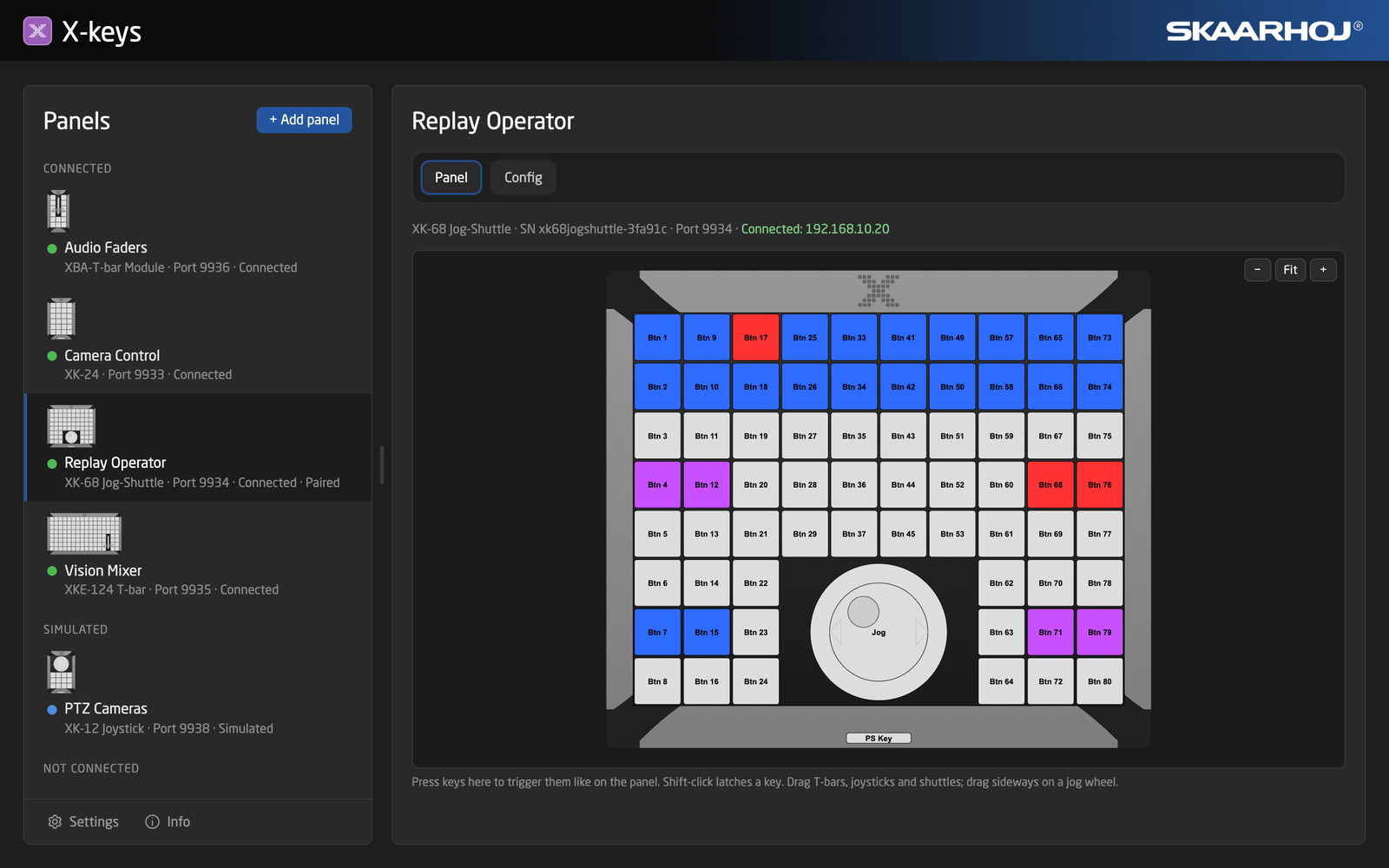
The list is grouped into Connected, Simulated, Not connected and Not added. Each row shows the model, port and state, e.g. Connected (a system such as Reactor is connected) or Running (waiting for one). The dot blinks on each trigger, so you can see which X-keys is in use. Right-click a row to remove it.
The on-screen panel works like the real one: click keys (shift-click latches), drag T-bars, joysticks and shuttles, and drag sideways on jog wheels.
Set up before the hardware arrives
A panel is only on the network while its X-keys is connected. To set up Reactor in advance, press Simulate on a panel, or create one with + Add panel:
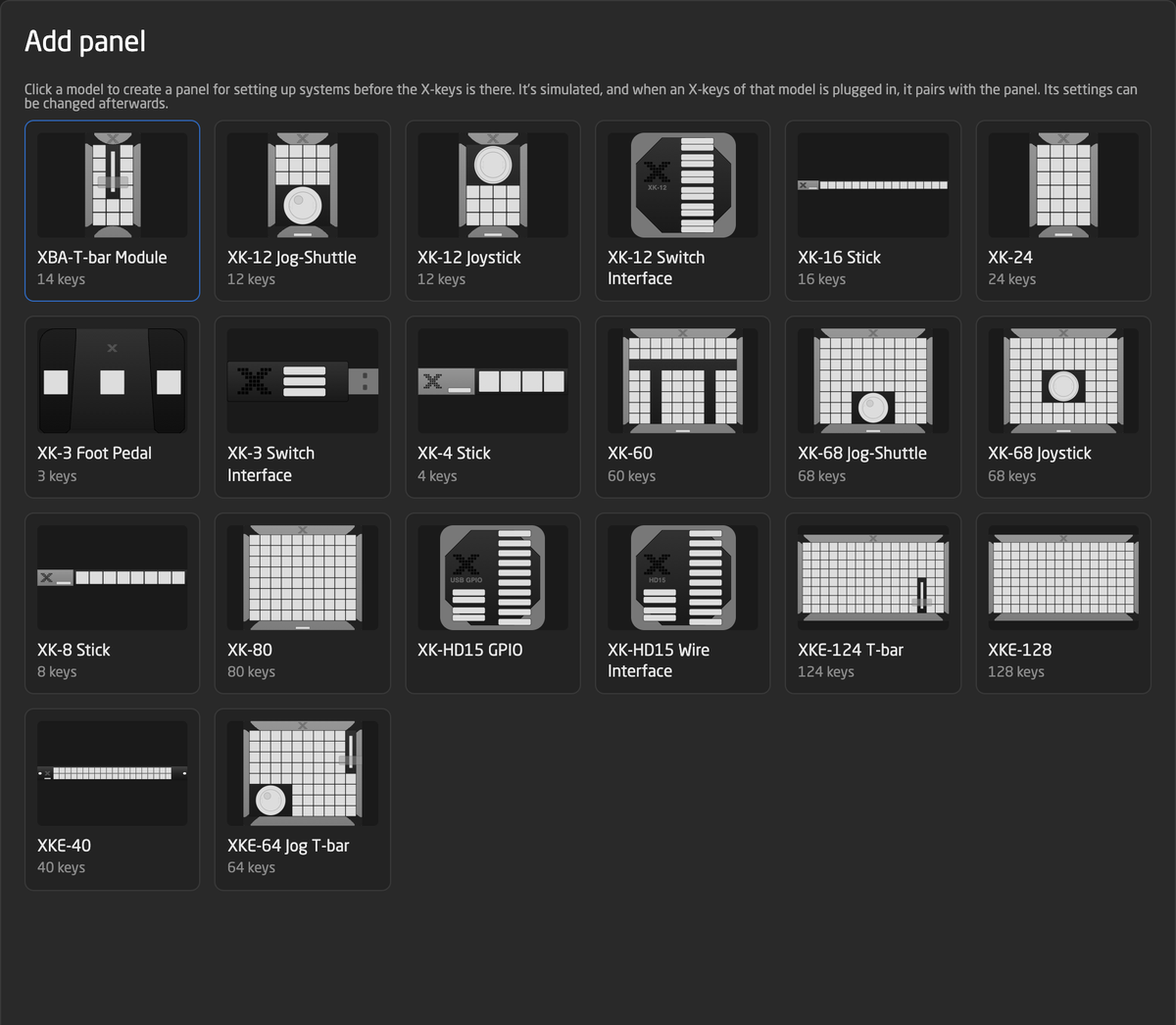
A simulated panel is on the network, accepts connections and is operated on screen, without using license points. The first X-keys of that model to be plugged in is paired with it and takes over without disconnecting anyone. You can also pair by hand under Physical X-keys in the panel's Config:

Several X-keys of the same model
Most X-keys have no serial number of their own, so the app makes one from the model, and all X-keys of one model look the same. Only one of them can be used at a time.
To use several, turn on Allow several panels of the same model in Settings. The serial number then includes the USB port, which has a catch: it changes if the X-keys moves to another port, and may change when the device or a USB hub restarts. Such X-keys are listed under Not added; add each with Add to the list:

The most stable solution is still one X-keys of a model per SKAARHOJ device: each is then on its own IP address and can keep the same port and serial number. X-keys with their own serial number (such as the XBA-T-bar Module) are not affected.
Configuration
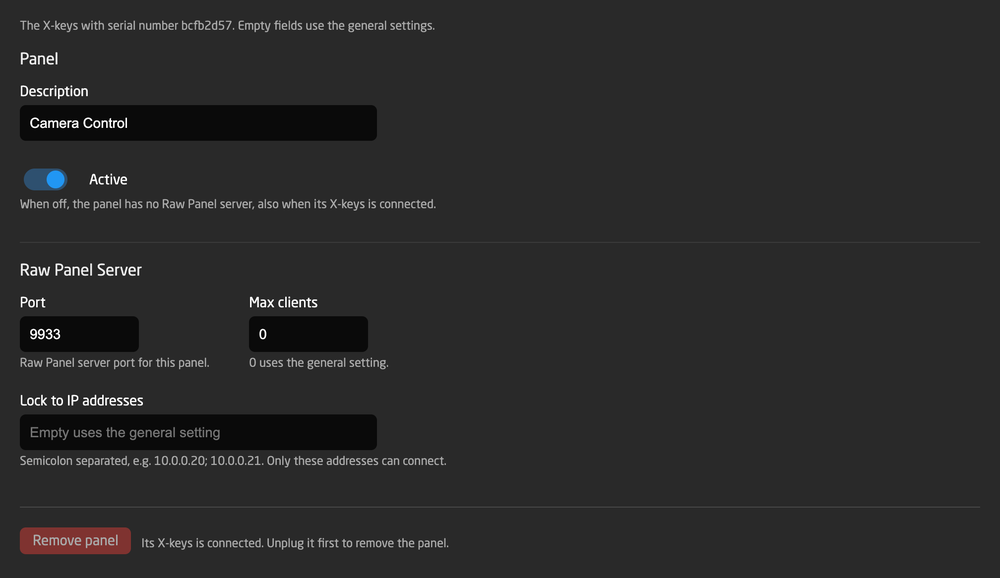
Each panel's Config has a description, Active, port, Max clients and Lock to IP addresses (basic protection on a friendly network). Changes save as you make them.
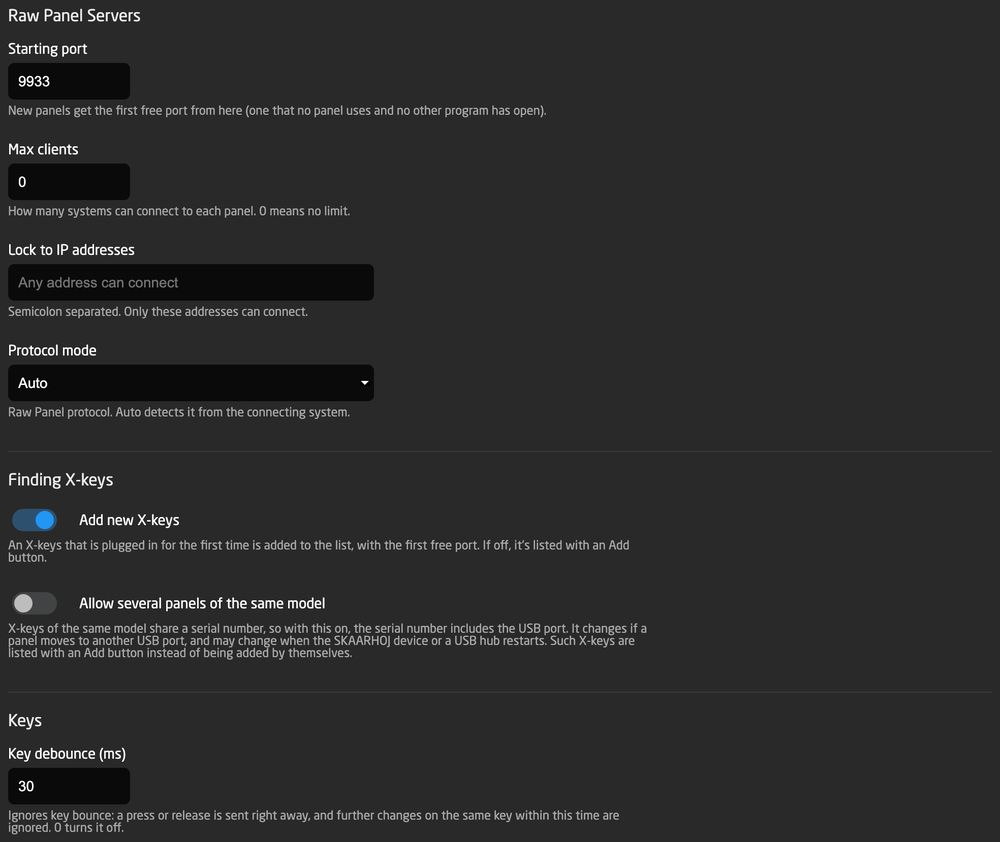
Settings holds the defaults for all panels: Starting port (9933), Max clients, Lock to IP addresses, Add new X-keys, Allow several panels of the same model, and Key debounce (for keys and pedals that bounce, default 30 ms). The Expert switch adds Protocol mode. Under Configuration you can export, import and restore the configuration.
Upgrading from version 1: old settings are converted on first start, and X-keys keep their ports. "Max panels without own settings" and "Keep each panel on its port" are gone: every X-keys now has its own panel.
USB Hubs
You can run several X-keys on one Blue Pill with a USB hub. A powered hub is recommended.
Licensing
Without a license, panels work for 10 minutes, starting 30 seconds after the app (re)starts. Then they pause: they still show what systems send, but presses and movements aren't sent. The app marks them Not licensed and shows a note under the list. Restarting the package gives another 10 minutes.

A license costs 83 EUR / 101 USD (January 2026) and covers 10 X-keys (1000 points, 100 per X-keys); licenses add up, and simulated panels don't count. Order from support@skaarhoj.com, sales@skaarhoj.com or the webshop, and include your Blue Pill's serial number.
Exploring with Raw Panel
Read the Raw Panel protocol, and try Raw Panel Explorer, now built into SKAARHOJ Discovery for Windows and Mac (download).
Discovery lists the SKAARHOJ devices on your network, including every X-keys panel. Turn on Expert in Discovery's Settings, select the X-keys, and click Explorer:
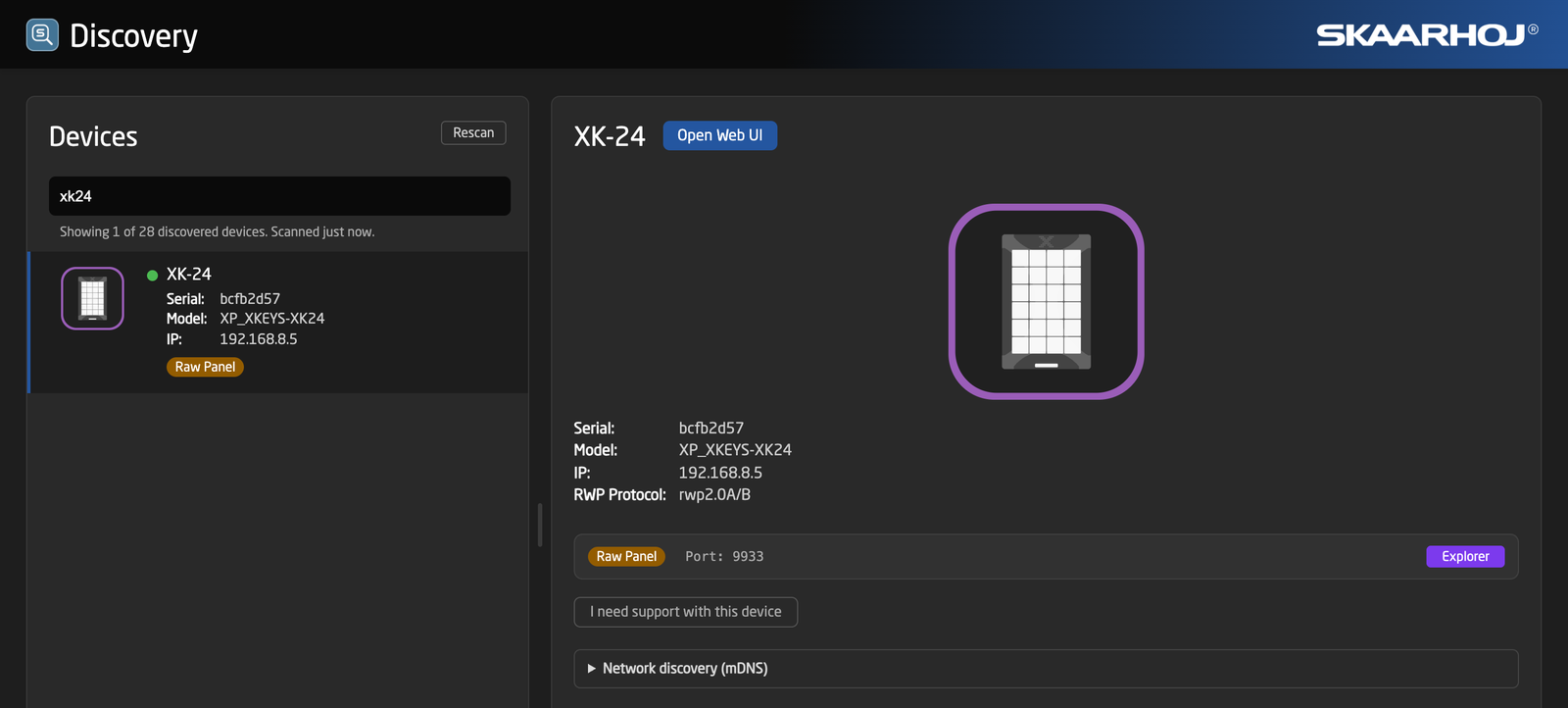
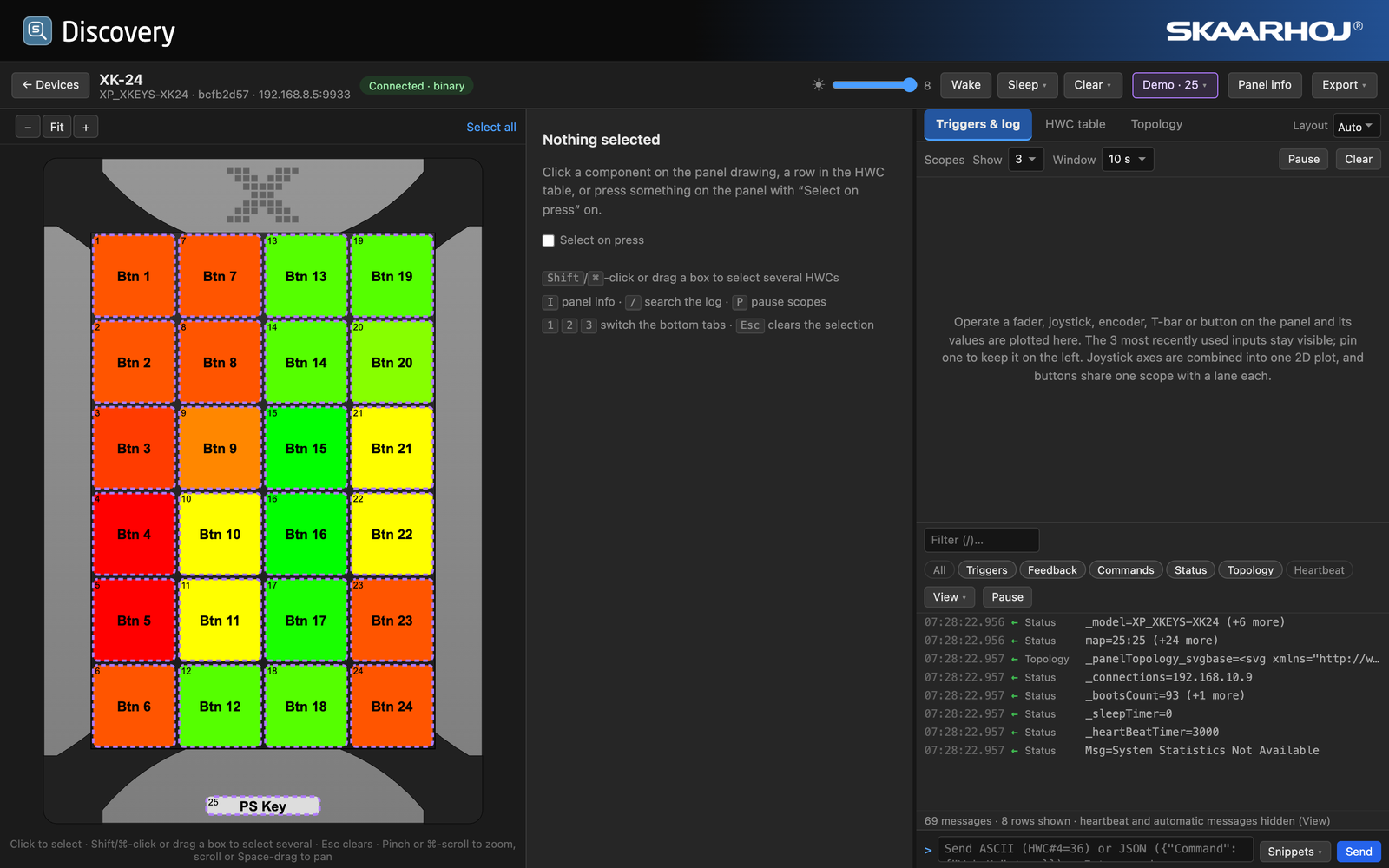
Explorer draws the panel, logs and plots triggers as you press keys, lets you send colors to selected keys, and has Demo shows. Here the Color wave demo runs on the XK-24 from the app screenshot at the top. Explorer draws the colors it sends; the app shows how the X-keys' blue and red LEDs render them:
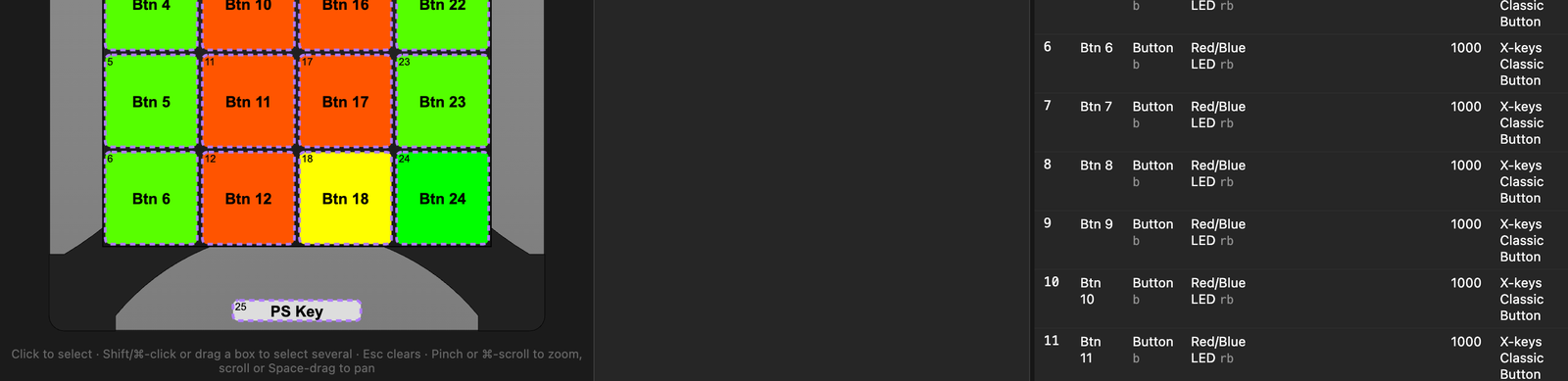
The drawing comes from the panel itself: any Raw Panel client can ask for the topology (JSON and SVG), which describes every component and how to draw it. The HWC table tab lists them:
Have fun! :-) Comments and questions are welcome at innovationlab@skaarhoj.com.
- kasper